The first 90 days as CFO, and the approvals nobody can find
New CFOs who map how requests really move tend to find the same thing: approvals running on email, no deadlines, and a team that stopped noticing years ago.
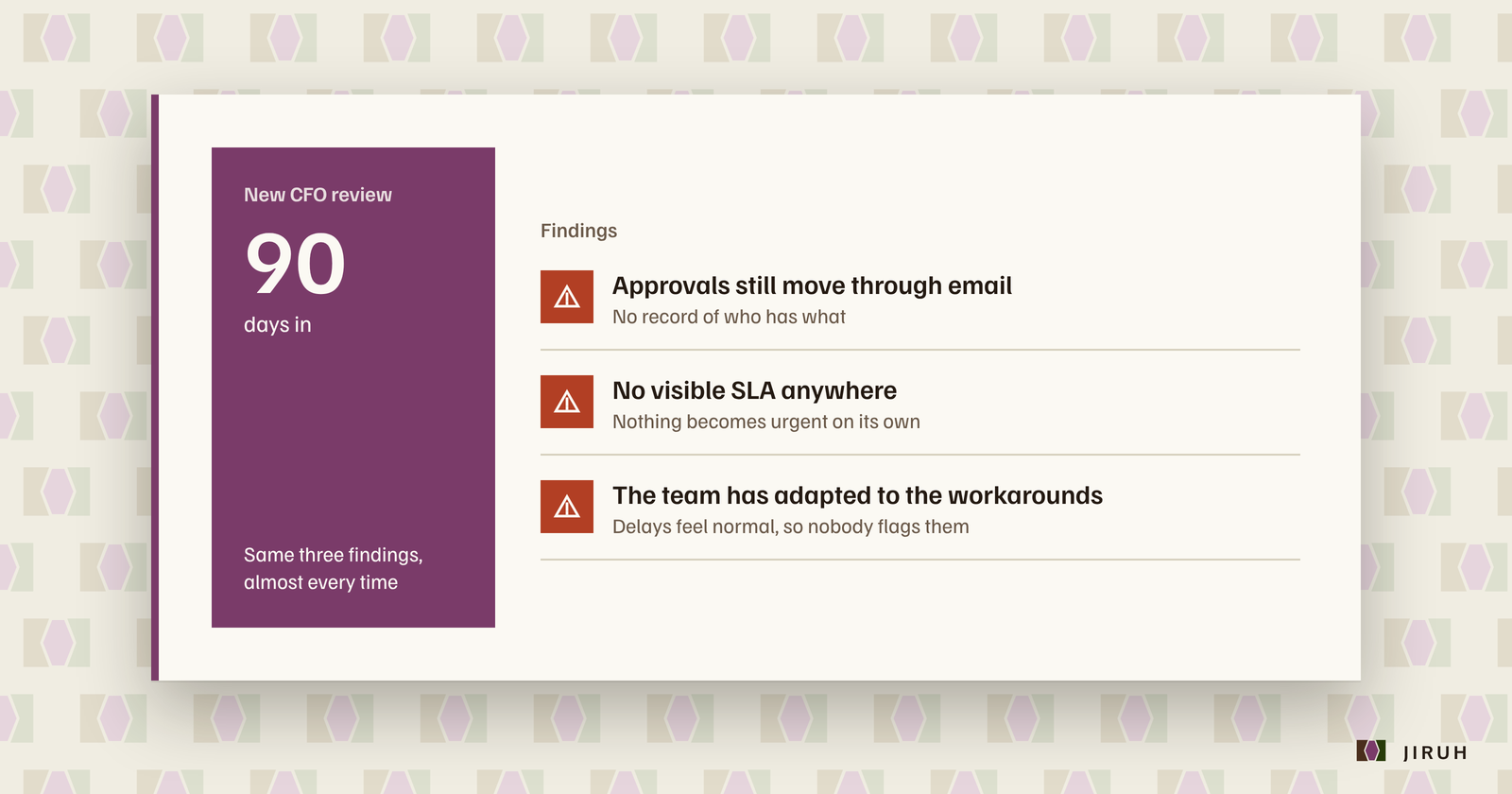
Most new CFOs do some version of the same exercise in their first three months. Sit with each function, ask how a request really gets from submission to decision, and write down every time the answer starts with “well, it depends”.
That list is always longer than the finance team expects. They’re used to the friction. They stopped seeing it a long time ago.
What turns up again and again: approvals moving on email and shared inboxes, no deadlines anyone keeps to, no single view of what’s outstanding, and no way to answer “how long does this usually take” with a number.
Don’t read it as a weak team
It’s tempting to treat all that as proof the team isn’t up to it. That’s almost always the wrong read.
A team that has run manual approvals for years has usually built clever workarounds. They know which approver needs a nudge on Mondays and who’ll sign if you catch them after lunch. That’s competence.
The problem is that workarounds don’t transfer. They live in one person’s head. They stop working when that person is on holiday, they leave with them, and nobody can audit them. Your job isn’t to criticise the workaround. It’s to replace the dependency on it.
Pick one approval type
Trying to fix everything in the first quarter is a mistake.
Pick the approval type with the most volume and the most complaints. Usually that’s purchasing or expenses. Fix its routing and make it visible before you touch anything else. A quick, visible win buys you credibility for the harder changes later.
What can wait: anything that needs a policy change, a new compliance framework or a negotiation between departments. Those take political capital you haven’t built yet at day ninety. Routing fixes don’t. The only buy-in they need is “please stop losing my request in your inbox”.
What the second year looks like
Treat the first fix as a proof of concept. Once people see purchase orders moving faster, the same managers who rolled their eyes at a process initiative in month one tend to ask, by month nine, why their approvals haven’t had the same treatment.
That’s the order that works. One visible win, then requests from inside the business to do more. A top-down overhaul of everything at once tends to get dropped the next time budgets get tight.
If you want the mechanics of the fix itself, they’re in where approvals actually get stuck.