Approvals and sign-offs
Where approvals actually get stuck
Most approval bottlenecks have nothing to do with strict rules. The request is waiting between two people, and nobody’s watching that gap.
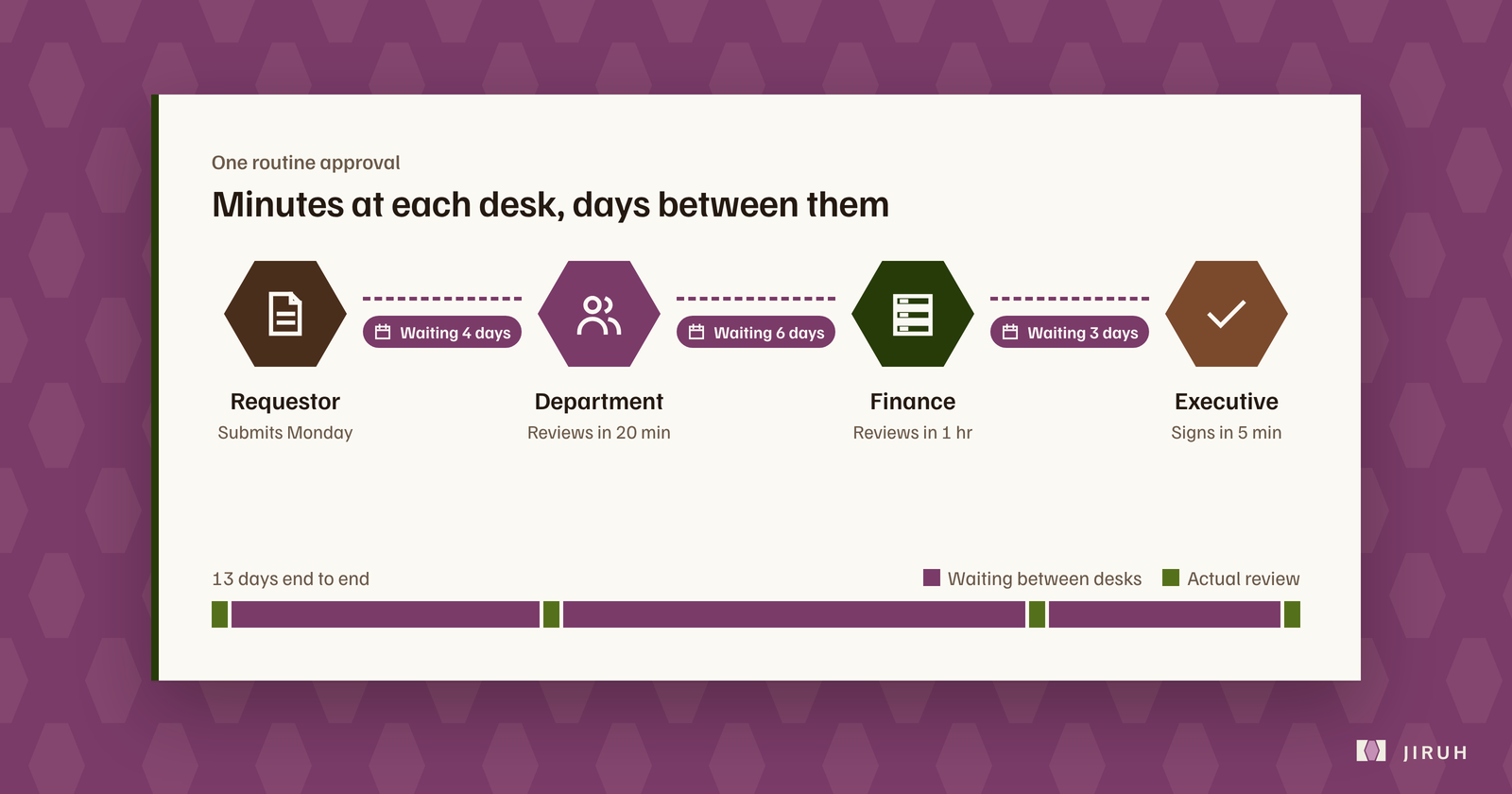
Ask a finance director why a $40,000 purchase order took six weeks and you’ll usually hear about policy. The threshold is too low. The paperwork is too heavy. Audit wants too much.
It’s a comfortable answer. It blames the rulebook instead of a person. It’s also nearly always wrong.
Time-stamp a stuck approval from end to end. Don’t look at the total. Look at how long it sat with each person before they touched it. The reviews themselves are short. Twenty minutes here, an hour there. The days pile up in between, while the request waits for someone to notice it arrived.
The gap between desks
Here’s how it usually goes. The request lands in an inbox the approver doesn’t check much, or a shared mailbox, or a form someone printed out. Nobody specific is on the hook for the next step, because it was sent to a department, not a person. There’s no deadline on it, so it never becomes urgent by itself. It waits until a vendor rings up asking for their money.
Then someone goes on leave. The request has nowhere else to go, so it waits for them to come back.
You’ll notice none of that is a policy problem. Every one of those delays survives a perfectly sensible procurement code. What fixes them is boring: a named owner for each step, a clock on each step, and a backup for when the owner is away.
That applies to purchase orders, contract redlines, records releases and hiring requisitions alike. The paperwork changes. The gaps don’t.
Adding approvers makes it slower
When something slips through, the reflex is to add another sign-off. One more department in the loop, just to be safe.
It’s an understandable instinct, but look at what it actually does. The decision still rests on the same information. The risk hasn’t moved. You’ve just added another inbox where the request can sit for four days.
A better question for every step in the chain: does this person ever change the outcome? If they’ve approved the last twenty requests without a single comment, they’re a rubber stamp. That step is pure waiting time. Merge it into the step before or after and nobody will miss it.
Send it to a role, not a name
The slowest-burning cause of approval decay is routing that points at a person. “Send it to Priya” works until Priya changes jobs. After that, requests either bounce or vanish, and nobody finds out until something breaks.
Route to the role instead. Finance approver for this cost centre, whoever that is this month. Keep one list of who holds which role and update it when people move. It’s a small change, and it removes a failure that named routing will hit sooner or later.
We wrote a separate piece on what that looks like in procurement, because it comes up more than anything else.
Measure the wait, not the total
Most teams start by measuring total time from submission to sign-off. It’s a fine number for a board report and a useless one for fixing anything, because it can’t tell you where the time went.
Measure dwell time instead: how long the request sat at each desk before anyone acted on it. Once you have that breakdown, the problem is usually sitting in one or two handoffs. Fix those and the whole cycle shrinks, even if every other step stays exactly as slow as before.
It also gives you something you can defend later. “We cut the wait at the budget office from five days to one” is a claim someone can check in six months. “Approvals are faster now” isn’t.
How mature is your process, honestly?
Most organisations fall somewhere on this scale for their messiest approval type:
Email threads and hallway reminders, where the only record is someone’s memory. Then a standard form with a known order of reviewers, though someone still has to remember to pass it on. Then automatic routing with a visible deadline and a backup approver when the deadline passes. And finally, the version audit teams want, where every step is logged with a name and a time and the whole trail exports in one click.
Policy documents tend to describe the third stage. Day to day, most teams are living in the first or second. That difference is where the six-week purchase order comes from.
A note on systems
None of this means replacing your finance or HR system. Routing sits on top of whatever already holds the record. It changes how a request moves between people, not where the data lives.
And a faster approval isn’t a riskier one. The same people make the same calls. They just stop waiting to be told it’s their turn.