What people are really buying when they buy workflow software
Nobody wants workflow software. They want a specific worry to go away, and that worry, more than the feature list, decides whether the tool gets renewed.
Nobody wants workflow software, the same way nobody wants a drill. They want the hole in the wall.
A city finance director doesn’t want approval routing. She wants vendors to stop ringing her to ask where their invoice went. A plant manager doesn’t want an OEE dashboard. He wants to get through a shift huddle without an argument about whose number is real.
Ask one more question
Ask a buyer what they need a tool for and you’ll get a task. Track approvals. Log downtime. Manage records requests.
Ask what happens when that goes wrong and you get the real answer, which is nearly always a worry. Being caught out by a request that’s been stuck for a fortnight. An auditor finding a hole in the paper trail. Standing in front of the board with a number nobody believes.
Whether the tool works, in the buyer’s eyes a year later, comes down to whether that worry went away. Two tools can have the same features and only one gets renewed.
The jobs that keep coming up
Most workflow purchases come down to one of a handful of jobs, whatever the industry.
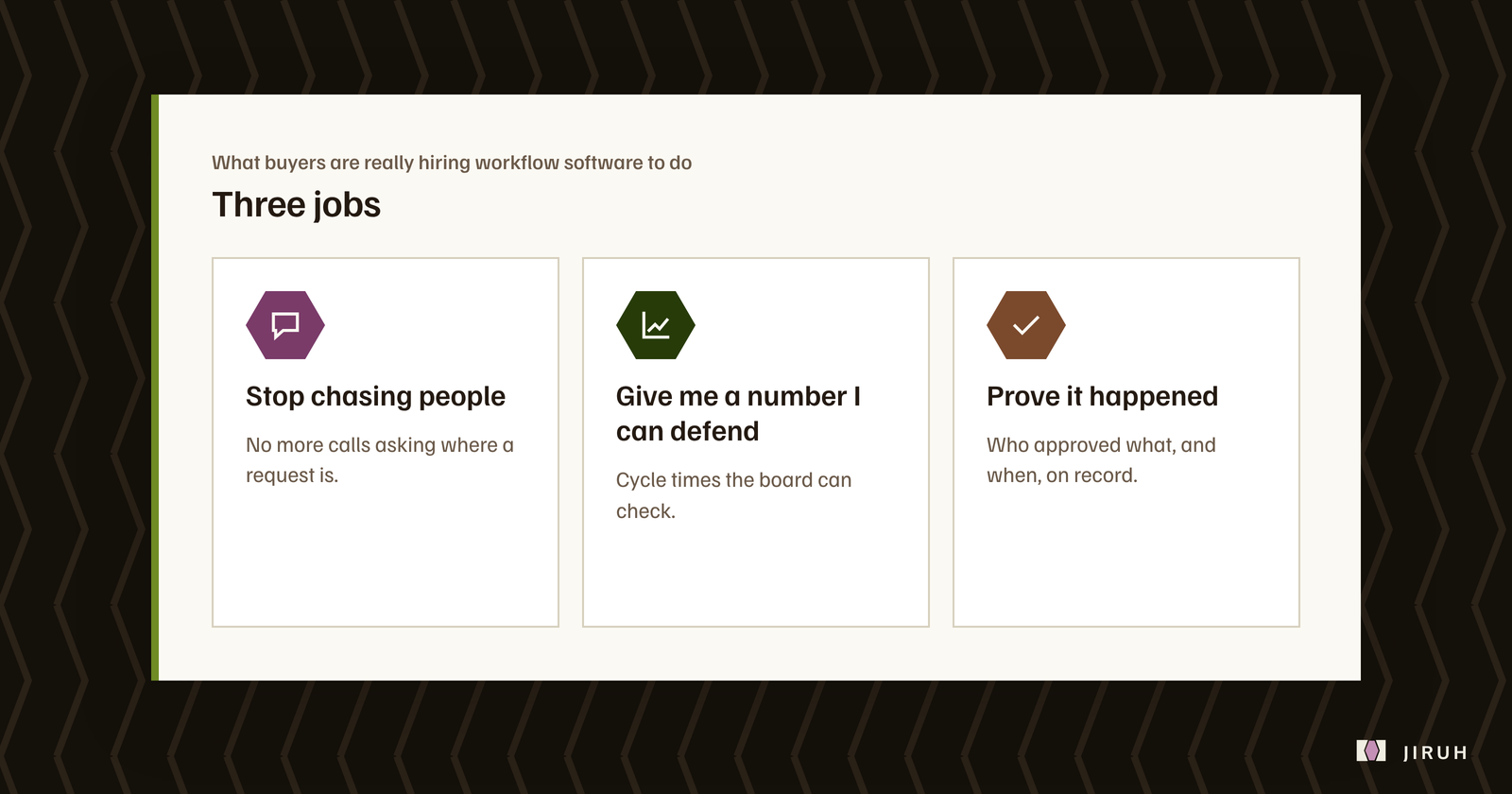
The most common is “stop making me chase people”. That’s the finance director, the head of procurement, anyone whose day disappears into finding out where things are.
Then there’s “give me a number I can defend”, for plant managers and compliance leads who have to stand behind a figure in front of people who might not trust it.
And for registrars and records custodians, it’s “make sure I can prove this happened”: a trail with times on it when the auditor or the subpoena arrives.
It makes evaluation easier
Once you know which job you’re hiring for, you can ignore most of the feature list.
If the job is to stop chasing people, the question is whether handoffs become visible and timed. How customisable the dashboards are hardly matters. If the job is a number you can defend, the question is whether the tool enforces one definition when the data is entered. The number of chart types is irrelevant.
Write the business case around the job
A business case built on features starts the wrong argument. Who has more integrations, more dashboard types, more settings. None of that tells you whether the worry goes away.
Built around the job, the case has to say whose week gets better and how you’ll know. “The finance director stops manually chasing signatures” is something you can check six months after go-live with one direct question.
Most buying processes never ask that question afterwards. That’s a big part of why so much workflow software gets bought, half used, and written off a year or two later.