A Tuesday in the city finance office
One ordinary day for a city finance director, spent mostly finding out who has things. Maria is made up. If you work in local government, you’ll know her anyway.
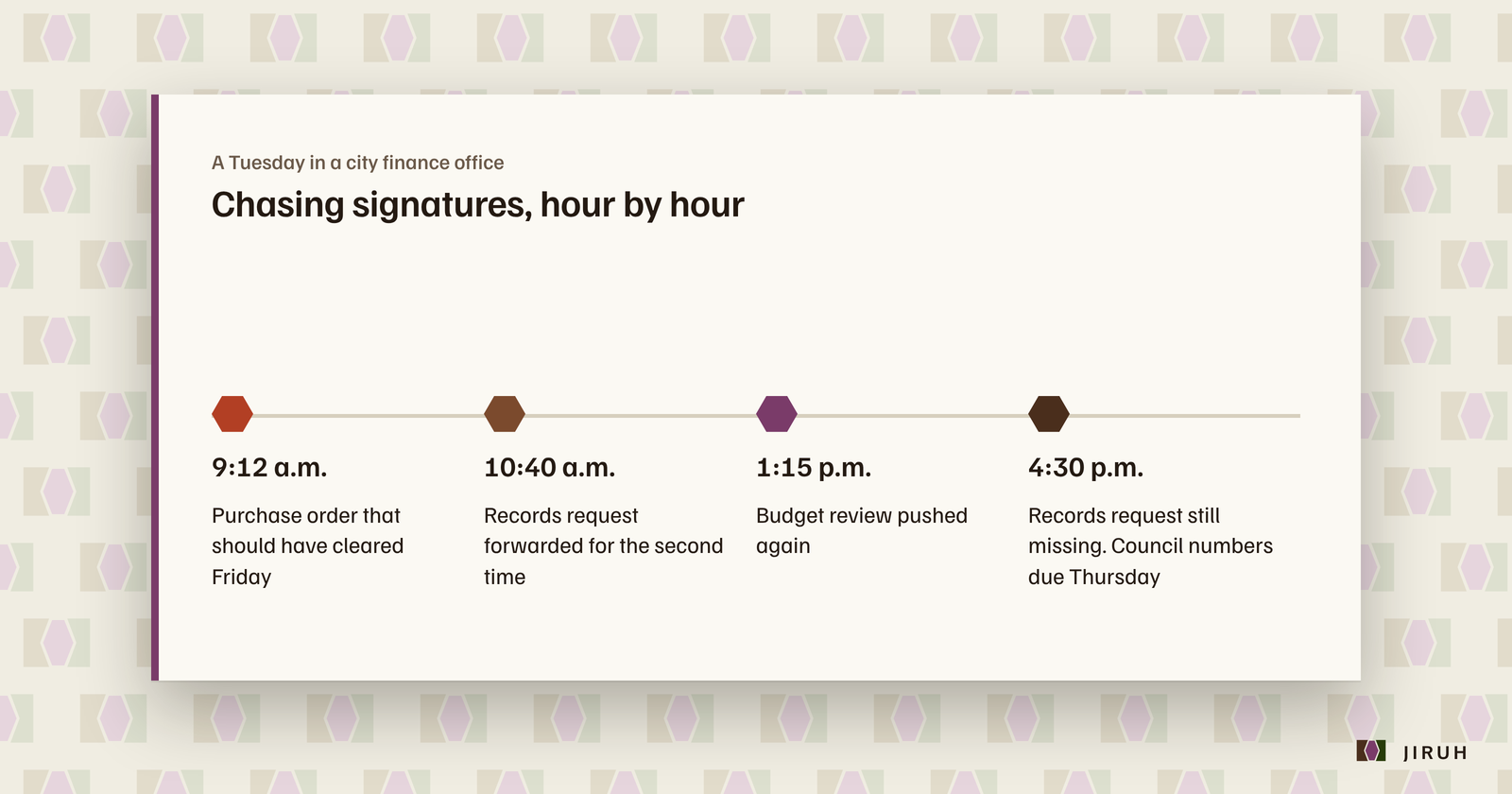
Maria isn’t a real person. She’s who we picture when we think about city finance offices, and if you’ve worked in one, her Tuesday will look familiar.
9:12 a.m.
First thing on her screen is a message from a vendor’s account manager. Very polite. Is the $40,000 fleet maintenance contract still going ahead?
It should have cleared on Friday. As far as Maria can tell from the shared inbox, it’s somewhere between the fleet department head and the budget office. Neither has mentioned it.
She spends the next twenty minutes doing what she does most Tuesdays, which is ringing round to find out who’s actually holding it. That isn’t in her job description. It has become a big part of the job anyway.
10:40 a.m.
A public records request from a local reporter arrives. It’s been forwarded from the city clerk, who got it forwarded from the mayor’s office. Nobody has started on it. It has just moved sideways twice.
Maria forwards it a third time, to the department that actually holds the records, and makes a mental note to chase it on Friday if she hears nothing.
There’s no system that knows this request exists, how old it is or who has it. The tracking system is Maria’s memory. Her memory is also holding the fleet contract, two budget questions and a spending breakdown a council member wants by Thursday.
1:15 p.m.
The quarterly budget variance review was meant to start at one. This is the work she was hired for.
It starts at quarter past, because the fleet department head finally calls back. By the time that call ends, she’s lost her place in the spreadsheet.
Nobody counts this in a workload study. The analysis isn’t what wears her out. It’s the stream of interruptions, every one of them about a request that should have told someone it was stuck.
4:30 p.m.
The fleet contract has moved. The budget office says it’ll sign on Wednesday. The records request from this morning is still somewhere she can’t see. The council breakdown will mean pulling numbers out of three systems by hand.
None of this is unusual. It’s a normal Tuesday.
What she would actually ask for
If you asked Maria what she wants, she wouldn’t say a new procurement platform. She’d say: one screen in the morning that shows what’s stuck, who has it, and how long it’s been there.
A call centre supervisor gets that view on day one. Finance directors almost never do. That’s the whole reason Maria spends her Tuesdays chasing signatures instead of reading budgets, and it’s a visibility problem. More staff wouldn’t fix it.
If this sounds like your office, where approvals actually get stuck goes into the fix.