OEE dashboards need the shift lead, not a redesign
Most OEE dashboards are accurate and still ignored. A better chart won’t change that. Getting the people who generate the data to own the number will.
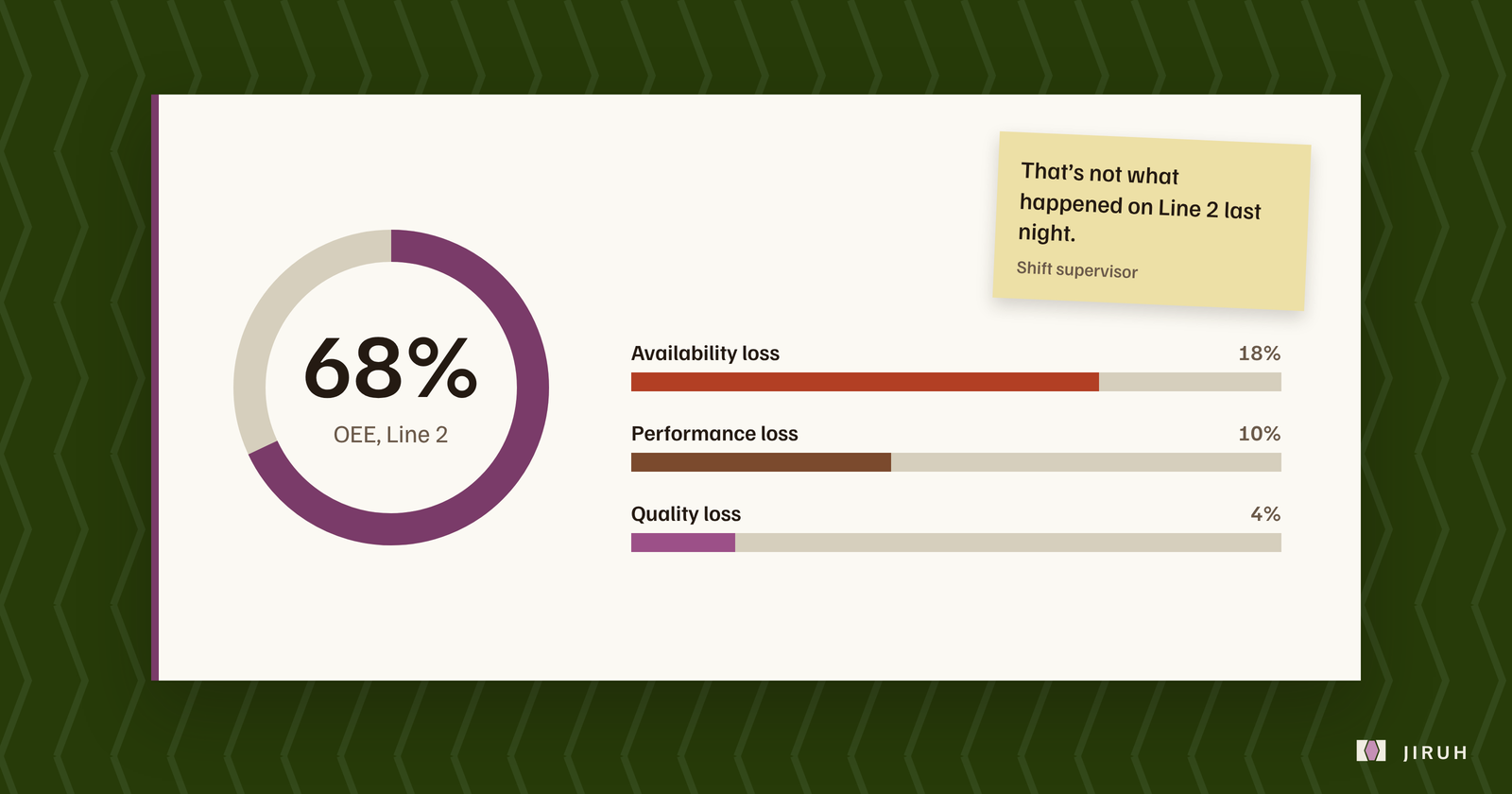
The number on the wall says 68%. The operators say it’s more like 80 once you take out the changeovers nobody logs. That argument happens every week, and it doesn’t move.
Adoption usually dies at the supervisor level, and the reason is plain. The metric belongs to an analyst two buildings away. The shift lead, the one person who could actually move it, has no stake in it at all.
A prettier chart fixes nothing
Plants spend real money redesigning OEE dashboards: new colours, drill-downs, a big screen by the canteen. If the people producing the data don’t see the number as theirs, none of that helps.
The usual sticking point is downtime. If a stoppage gets argued into a category after the fact, every red cell becomes a debate, and the redesign just shows the same debate in nicer colours.
Settle who owns the codes first
Before touching the software, decide two things in writing. Who’s allowed to close a downtime code. And how quickly a disputed one gets resolved.
Once that’s settled, almost any dashboard tool will do the job. Until it’s settled, no dashboard tool will.
Make the reason codes survivable
A reason-code list has to survive a busy shift. If logging a stoppage means ninety seconds of hunting through a twenty-item dropdown, operators pick whatever’s quickest. The data drifts, and you’re back to arguing.
Build the list with the people who’ll use it. Keep it to five to eight codes, worded the way the floor talks. Review it every quarter with the shift leads, and don’t let an analyst rewrite it on their own.
People trust a list they helped write.
Put it in the shift handover
Run the OEE review through the handover itself. Same codes, same five minutes, same named owner, every shift.
Done that way, the number becomes something the floor uses to run the line. Most of the time, that’s what was missing.
This is one part of a wider problem with plant metrics, which we go into in why nobody on the shop floor believes the plant dashboard.